Wednesday, July 2, 2014

Courts set stage for historic Peel trial

When the curtain rises on the Peel watershed trial in Whitehorse July 7, it’s expected to be so popular two Yukon courtrooms have been set aside to seat up to 200 spectators.
More than 50 First Nation elders from the four Peel region First Nations will line the benches alongside their political leaders and the many others with an interest in this case.
And for the first time in Yukon court history, the first 2 1/2 hours of the trial will be video-taped by the claimants to document this historic occasion.
What began as a dispute over protecting the Yukon portion of the transboundary drainage has mushroomed into a major brawl about the meaning of modern-day treaties.
A drama years in the making, with plenty of public input along the way, it’s easy to see why so many may want to watch the next act unfold in courtroom #1 - live video-streamed to courtroom #3 - during the five-day trial.
Many more months may pass before Yukon Supreme Court Justice Ron Veale renders a decision. Add to that two to four years of appeals, possibly all the way to the Supreme Court of Canada, and this saga may not finally conclude until 2019 or 2020.
The lawsuit against the Yukon government was launched in January by the Na-cho Nyak Dun, Tr’ondek Hwech’in, Yukon Conservation Society and CPAWS-Yukon.
The NWT’s Gwich’in Tribal Council joined the case as intervenors on June 20.
GTC acting president Norman Snowshoe said the council decided to add its name to the legal roster, rather than launch its own suit, to make sure its voice was heard.
“We’ve done the analysis as to how to ensure our interests are best met in this process….and we believe that participating with the other First Nations in this case would get us the results that we need and ensure that our rights are protected through the legal system,” said Snowshoe in an interview from the council's Inuvik headquarters.
Snowshoe and his board plan to attend the trial “to show that we are here to protect the rights that the land claim negotiators established when they finalized the land claims agreement [in 1992].”
Former justice and B.C.-based lawyer Thomas Berger, of Mackenzie Valley Pipeline Inquiry fame, is leading the legal charge for the First Nations and environmentalists.

They say the Yukon broke the land claim agreements by rejecting the Peel commission’s land use plan at the 11th hour. Both the government and First Nations appointed people to the six-member commission.

The government, on the other hand, denies any wrongdoing. It claims it had the right to replace the commission’s plan – which protected 80 per cent of the watershed – with one that opens most of the region’s public land to industrial development.
While the black-robed lawyers argue the law within the courtroom walls, environmentalists have planned a series of Peel-related events outside and beyond.

To mark the trial’s opening day, a silent vigil will be held on the courthouse steps over the noon hour July 7.

At the nearby Kwanlin Dun Cultural Centre, beside the Yukon River, a ceremonial fire will be lit and tended daily to provide a place for Peel supporters to gather. Inside there’ll be an elders’ lounge, with shuttle service to and from the courthouse.

The centre also will host an evening of stories, images and music, dubbed Voices of the Peel, on July 10.

In Dawson a daily noon prayer circle will be held throughout the week. Edmonton motorcyclist Don Curry begins a ride from there to Inuvik July 7 – standing up on his bike the whole way to encourage people to stand up for the Peel.

Monday, June 16, 2014

Yukon gov't defends Peel plan rejection


The land use planning process doesn't seem to carry much weight with the Yukon government.

And it's going to use the Peel watershed plan lawsuit to try to prove that point.

The suit was filed by two First Nations - the Na-cho Nyak Dun and Tr'ondek Hwech'in - and the Yukon Conservation Society and CPAWS-Yukon in January after the government rejected the final recommended plan prepared by the Peel planning commission.

The commission's plan protected 80 per cent of the watershed while the government's new plan opens most of the region to industrial development.

In its outline of the arguments it plans to use in the upcoming July 7-11 trial, the Yukon government says it had every right to ignore the work done by the Peel commission.  The six-member commission, made up of government and First Nation appointees, spent seven years and $1.5 million studying, analyzing and consulting on how to best manage the Yukon portion of the transboundary watershed.

As far as the government's concerned it had no legal obligation to do a land use plan despite the fact there's an entire chapter in the constitutionally-protected land claimsagreements that provides a template for how land use plans are to achieved.

"Chapter 11 provides a voluntary planning process that ensures that both government and First Nations can participate in the process and be consulted with respect to any final proposals, but which leaves the ultimate decision-making authority in the hands of government for non-settlement lands and First Nations for settlement lands," it says.

About 97 per cent of the Peel region is non-settlement land.

"The Yukon government has consistently stated that it required a balanced approach to planning on these lands. When the commission declined to provide a recommended plan that was balanced, it was open to the government, after proper consultation to modify the plan, to achieve that balance."

The case has ramifications not only for the Peel plan, but also for modern-day treaties in general and whether they are worth the paper they're written on.

Click here to read the government's full 48-page argument.

Click here to read the claim against the government.

Tuesday, May 13, 2014

Berger lays out Peel legal argument

More details on the case against the Yukon government's handling of the Peel watershed land use plan have been filed with the courts.

The 48-page legal argument by Thomas Berger, who is representing two Yukon First Nations and two environmental groups in the lawsuit, builds on the information contained in their statement of claim.

They want the court to force the Yukon government to approve the final recommended land use plan for the watershed. It was produced by the Peel commission, which had appointees from both government and First Nations. Rather than work with that plan, the government imposed its own new plan for the region a few months ago.

Click here to read Berger's full argument.

The government has until June 9 to respond to the arguments put forth. So far it has only filed a statement of defence.

The trial in Yukon Supreme Court is scheduled for July 7-11.

Friday, May 9, 2014

Big Peel payouts bogus boogie man: Berger

The Yukon government would have no legal obligation to compensate the Peel’s mineral claimholders if it accepted the final recommended land use plan, says lawyer Thomas Berger.

Implementing a land use plan with no surface access is not “defacto expropriation” of mining claims, the prominent B.C. lawyer says in a legal opinion prepared for the Yukon Conservation Society and CPAWS-Yukon.

Berger is representing the two groups and two Yukon First Nations in a suit against the Yukon government’s decision to open most of the Peel for industrial development.

Here is the executive summary of the 33-page Berger opinion:

We have considered whether, if the Final Recommended Plan (FRP) of the Peel Commission is implemented, the Government of Yukon (YG) would be obligated to compensate owners of mineral claims or other property interests within protected areas for economic loss resulting from restrictions on the use of their land.

This issue arises because of the provision in the FRP that surface access to existing mineral claims would not be permitted in protected areas (though access by air would be allowed).

It is vital to keep in mind that instituting a program of land use planning is not the same thing as expropriation. When a specific parcel of land is expropriated, the owner is entitled to be compensated under the Yukon Expropriation Act R.S.Y. 2002, c.81. But the implementation of a land use plan for the Peel Watershed would not constitute expropriation of anyone’s land or anyone’s mineral claim. Instead it is what the Supreme Court of Canada has described as “the broad assignment of land use.” Tener v. B.C. [1985] 1 S.C.R. 533. The Supreme Court in Tener compared land use planning to zoning. When your property is rezoned, you are not compensated. Everyone whose land is rezoned must live with what may well be a very serious limitation on the use of such land.

The Supreme Court has held in Canadian Pacific Railway v. Vancouver [2006] 1 S.C.R. 227 that, to amount to de facto expropriation, two conditions must be met:

1. The government must acquire a beneficial interest in the land in question. In the Yukon we are mainly concerned with the owners of mineral claims. In the case of the implementation of the Peel Commission’s FRP, YG acquires no beneficial interest in the mineral claims.

2. Removal of all reasonable uses of the land. Thus the economic value of the land to the owner of the mineral claim must be reduced to the point where it is of no real use for exploiting minerals. It could be argued this would be the outcome under the FRP, since there would be no access except by air.

Let me repeat: The law in Canada, as enunciated by the Supreme Court, is that both conditions must exist for there to be a de facto expropriation and thus a right to compensation. In this case there would be no acquisition by YG of a beneficial interest in any mineral claim or in any other property. So YG would have no legal obligation to pay compensation.


Tuesday, May 6, 2014

Portrait of a Peel protest

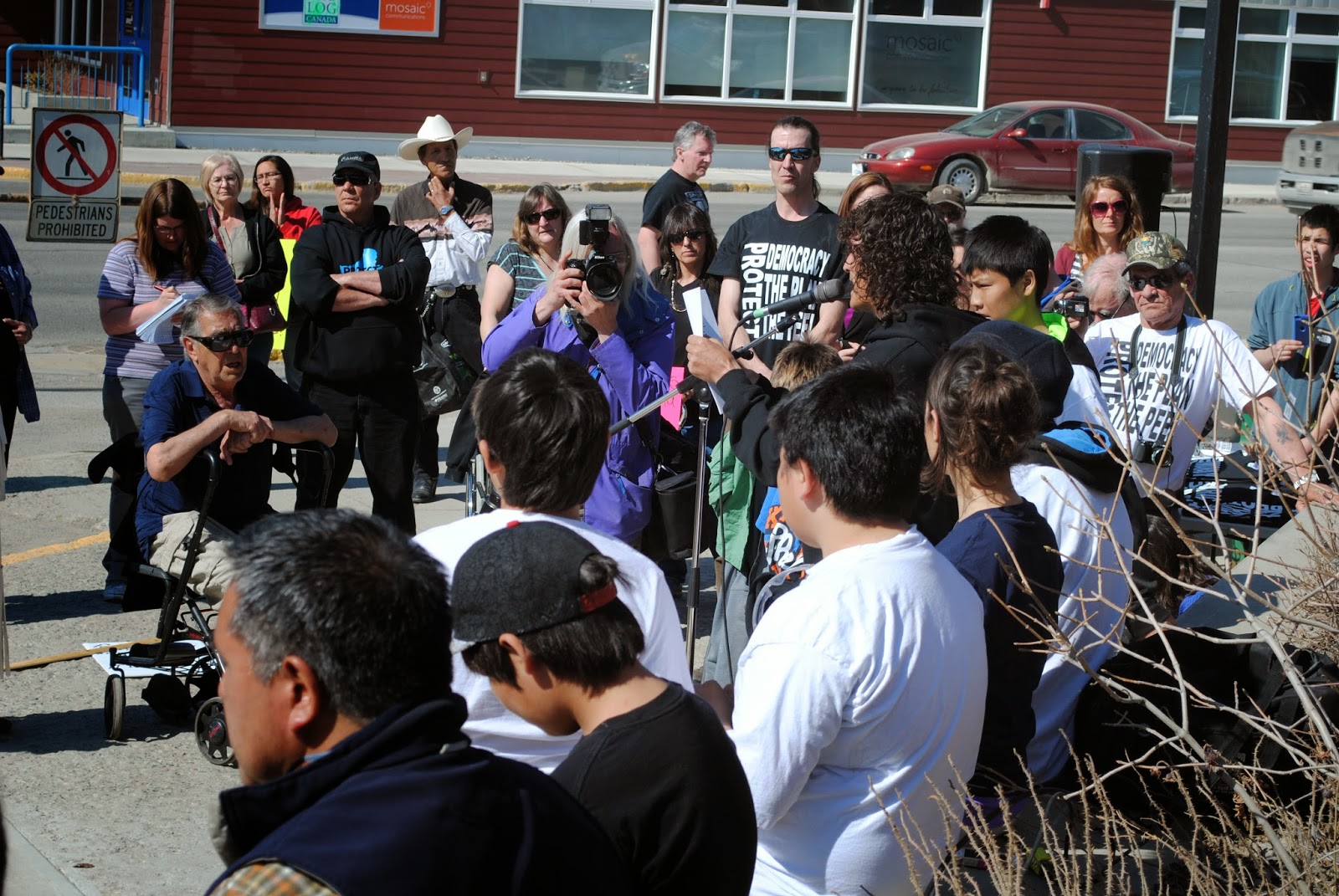
THE LAST MILE...Na-cho Nyak Dun elder Jimmy Johnny hoofs it along the Yukon River with about 100 other protesters who joined the procession to the government building behind Brad Firth, aka Caribou Legs. He used his athletic prowess to run 1,200 kilometres from Inuvik with a message for the Yukon government: protect the Peel watershed.  


NO WELCOME MAT...Yukon Premier Darrell Pasloski didn't come out to greet the marchers or receive the letters, but the media were more than happy to listen to the messages.
TREATY REWIND...Former Na-cho Nyak Dun chief Robert Hager wants to know what happened to joint land planning commitments made in the treaties he signed more than 20 years ago.
 

PEOPLE OF THE PEEL...Reverend Mary Battaja pays tribute to those, like her mother, who came before and their historic ties to the land.


HOT DOG...Firth's faithful Trixie, decked out with a canvas pack to carry the letters, seems to prefer playing over protesting.
EYE ON THE PRIZE...Peel protesters vow to fight on as the dispute near its day in Yukon Supreme Court. The trial is set for July 7 - 11.


Tuesday, April 29, 2014

Caribou Legs completes epic Peel run

Gwich'in long distance runner Brad "Caribou Legs" Firth arrived in Whitehorse Tuesday after running 1,200 kilometres from Inuvik to protest the Yukon's government's decision to open the Peel watershed to industrial development. He plans to deliver that message in person on May 5.
 

Thursday, April 3, 2014

Carried by Caribou Legs

Gwich’in long distance runner Brad “Caribou Legs” Firth kicked off his epic 1,200-kilometre journey from Inuvik to Whitehorse this week.

The modern-day mailrunner is carrying a packet of letters to Yukon Premier Darrell Pasloski from Mackenzie Delta people concerned about the future of the Peel watershed.

Much of his trip down the Dempster Highway will be in the Peel watershed. He’ll cross the lower river at Fort McPherson and once in the Yukon he'll run through the Ogilvie and Blackstone River valleys.

If all goes according to plan – and that’s always a bit of a gamble when dealing with the notoriously stormy Dempster country - he hopes to complete the run and deliver the letters April 22.
Firth, who was born and raised in Inuvik but later moved to Vancouver, returned to the North last year to raise awareness about substance abuse. The former crack addict credits long distance running with pulling him out of the abyss.
Last year he ran 740 kilometres from Fort Smith to the N.W.T. capital of Yellowknife in 10 days.
Click here to track his progress.
Meanwhile fundraising continues for the Peel lawsuit against the Yukon government filed by two First Nations and two environmental groups. The trial is set for July 7-11.
They say they've raised nearly half of their $100,000-goal and there are more events planned.
The What About the Peel? art show by Yukon Artists at Work at their Whitehorse gallery on Industrial Road opens April 4 and runs to April 28.
The Yukon Youth Indoor Climbing Team’s Peel Climb-a-thon fundraiser is  April 5 from 8 a.m. to 8 p.m. at 1307 in Porter Creek. And the Zip-line for the Peel fundraiser at Equinox Rocks April 12.